- Login
- Sign Up

World Aquatics Diving Pool Requirements
Diving facilities are among the most technically demanding aquatic venues to design and construct. Unlike conventional swimming pools, diving pools must meet strict World Aquatics requirements relating to water depth, platform heights, springboard specifications, structural clearances, athlete safety, and competition equipment.
Whether you are planning a new aquatic centre, upgrading an existing diving facility, or evaluating a venue for national and international competitions, understanding World Aquatics diving standards is essential.
This guide answers some of the most frequently asked questions regarding diving pool requirements and facility design.
What are the World Aquatics Requirements for a Diving Pool?
A World Aquatics-compliant diving facility must provide the appropriate combination of springboards, platforms, water depth, clearances, lighting, and competition equipment required for the level of competition being hosted.
The facility must be designed to ensure athlete safety throughout all phases of training and competition. Particular attention is given to water depth beneath the diving apparatus, horizontal and vertical clearances, non-slip surfaces, and visibility of the water surface.
In addition to the physical structure, facilities hosting major competitions must also provide electronic judging systems, scoreboards, athlete preparation areas, and other supporting infrastructure.

What are the Standard Diving Platform Heights?
World Aquatics recognises five standard platform heights:
- 1 metre
- 3 metres
- 5 metres
- 7.5 metres
- 10 metres
The 10-metre platform is the highest platform used in Olympic and World Championship competition and is often considered the signature feature of a diving facility. Each platform must provide sufficient space for athletes to perform safely and must be constructed with a stable, non-slip surface. For facilities intending to host high-level competitions, all platform heights are typically incorporated into the design.
What are the Standard Springboard Heights?
World Aquatics competition diving uses two springboard heights:
- 1-metre springboard is commonly used in age-group, developmental and senior competitions
- 3-metre springboard is used in Olympic Games, World Championships, and most elite competitions
Both springboards must meet strict dimensional and performance requirements to ensure consistent athlete experience and competition fairness.
What size is a Competition Diving Springboard?
World Aquatics specifies that competition springboards must generally be between 4.8 metres and 5.0 metres in length and approximately 0.5 metres wide.
The springboard surface must be slip-resistant and fitted with an adjustable fulcrum. The fulcrum allows divers to modify the flexibility of the board according to their preference and the specific dive being performed.
Modern competition facilities often utilise springboards manufactured by specialised suppliers that have been tested and approved for international competition use.

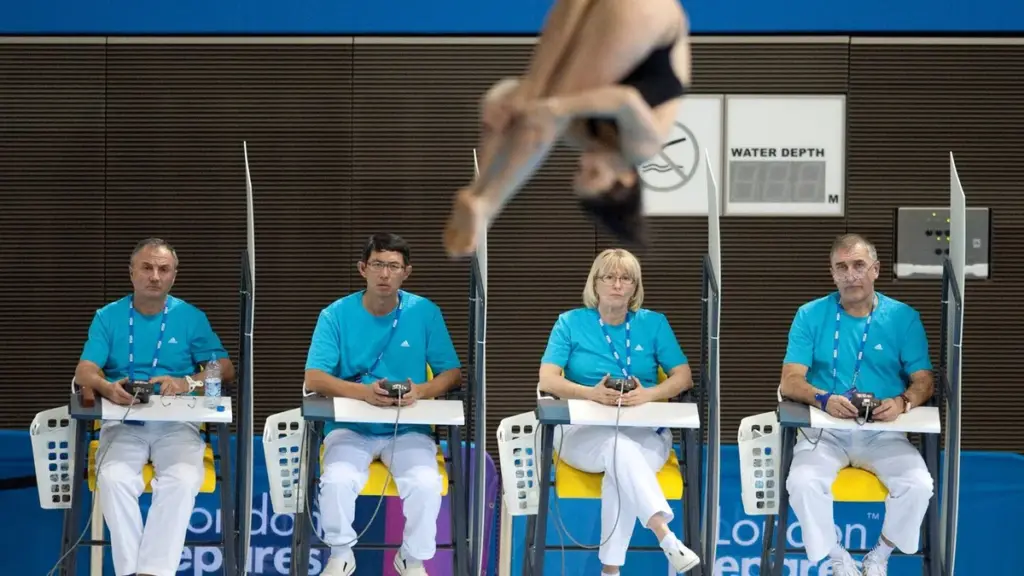
What Equipment is required for International Diving Competitions?
In addition to the diving structures themselves, major competitions typically require:
- Electronic judging systems
- Competition scoreboards
- Athlete information displays
- Video replay systems
- Timing and event management software
- Public address systems
These systems help ensure accurate scoring, efficient event management, and a professional competition environment.
How deep must a Diving Pool be?
Water depth is one of the most critical safety requirements in diving facility design.
The required depth varies depending on the height of the diving apparatus.
For example:
- 1 m springboard facilities generally require a minimum depth of approximately 3.4 metres
- 3 m springboard facilities generally require a minimum depth of approximately 3.7 metres
- 5 m platforms generally require a minimum depth of approximately 3.8 metres
- 5 m platforms generally require a minimum depth of approximately 4.1 metres
- 10 m platforms generally require a minimum depth of approximately 5.0 metres
These requirements help ensure sufficient clearance beneath divers entering the water at high speeds and are fundamental to athlete safety.
Why are Pool Clearances Important in Diving Facilities?
When divers leave a springboard or platform, they travel both vertically and horizontally before entering the water.
To accommodate these movements safely, World Aquatics establishes minimum clearances between:
- Springboards and platforms
- Adjacent diving apparatus
- Pool walls
- Water entry areas
Proper clearances help prevent collisions and ensure that athletes have unrestricted space to perform complex dives safely.
For architects and engineers, clearance requirements are often among the most important factors influencing the overall layout of a diving facility.
What is a Bubbling System and Why is it used?
Many modern diving pools are equipped with a bubbling or agitation system.
This system releases air bubbles beneath the water surface, creating visible disturbance in the water directly below the diver.
The bubbling effect serves several purposes:
- Improves visibility of the water surface
- Helps divers judge their distance to the water
- Reduces the visual impact of a perfectly still surface
- Enhances athlete confidence during training and competition
Bubbling systems are particularly common in facilities with 10-metre platforms.
What Water Temperature is required for Diving Pools?
World Aquatics regulations generally require diving pool water temperatures to be maintained at not less than 26°C.
Maintaining a stable water temperature helps ensure athlete comfort and consistent competition conditions.
Modern aquatic centres typically incorporate advanced filtration and temperature control systems to maintain compliance throughout training and competition periods.
What Lighting is required for Competition Diving?
Lighting is a critical aspect of diving facility design.
Divers must be able to maintain visual orientation throughout their approach, take-off, flight, and water entry. Poor lighting can negatively affect performance and increase safety risks.
World Aquatics competition venues typically provide high levels of uniform illumination while minimising glare that could interfere with athlete vision.
Lighting systems must also support television broadcasting, photography, judging operations, and spectator viewing.
What Facilities are recommended for Diver Training?
Modern diving centres often include specialised dryland training facilities to complement water-based training.
Common features include:
- Harness systems
- Foam pits
- Strength and conditioning areas
These facilities allow athletes to practise techniques and develop skills in a controlled environment before performing dives in the water.
What makes a Diving Facility World Aquatics Compliant?
A World Aquatics-compliant diving facility must satisfy technical requirements covering:
- Platform heights
- Springboard specifications
- Water depth
- Safety clearances
- Water temperature
- Lighting
- Competition equipment
Compliance is essential for facilities seeking to host international competitions, national championships, elite training camps, and athlete development programmes.
For developers and facility owners, designing to World Aquatics standards helps future-proof the venue and maximise its long-term value.
Planning a World Aquatics Diving Facility
Designing a diving pool involves significantly more than simply installing platforms and springboards. Every aspect of the facility must be carefully coordinated to ensure safety, performance, operational efficiency, and compliance with international standards.
By working with experienced aquatic consultants, designers, and equipment specialists, facility owners can create diving venues capable of supporting everything from community programmes to Olympic-level competition.
Whether your project involves a new aquatic complex, a competition venue upgrade, or a national training centre, understanding World Aquatics diving pool requirements is the first step toward delivering a world-class facility.
