- Login
- Sign Up

World Aquatics Competitive Swimming Requirements
Whether you are planning a new aquatic centre, upgrading an existing competition pool, or preparing a facility for national or international events, understanding World Aquatics swimming pool requirements is essential. World Aquatics establishes the international standards used for Olympic Games, World Championships, regional competitions, and many national-level swimming events.
This guide answers some of the most frequently asked questions about competition swimming pool design, dimensions, equipment requirements, and certification standards.
What are the World Aquatics Requirements for a Competition Swimming Pool?
A World Aquatics compliant competition pool must meet strict standards relating to length, width, depth, water temperature, timing equipment, lane markings, starting platforms, and other competition infrastructure.
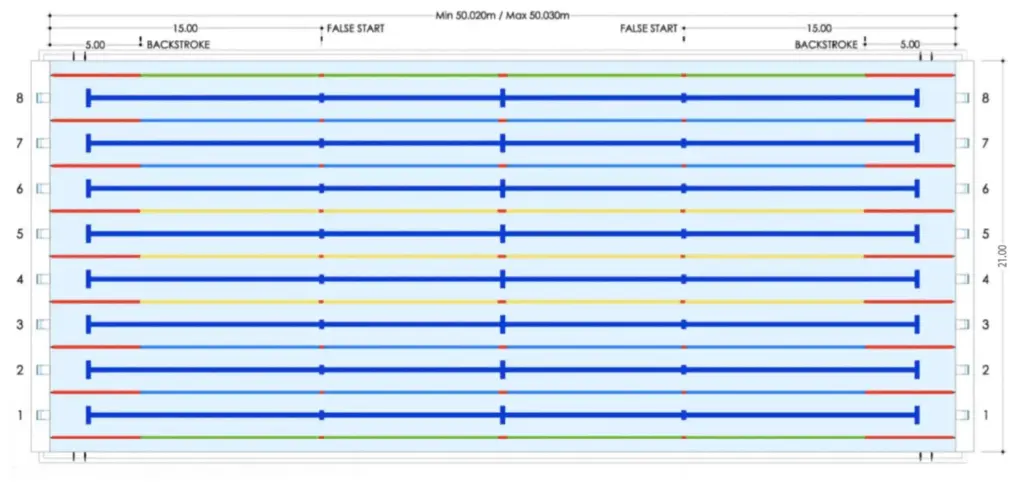
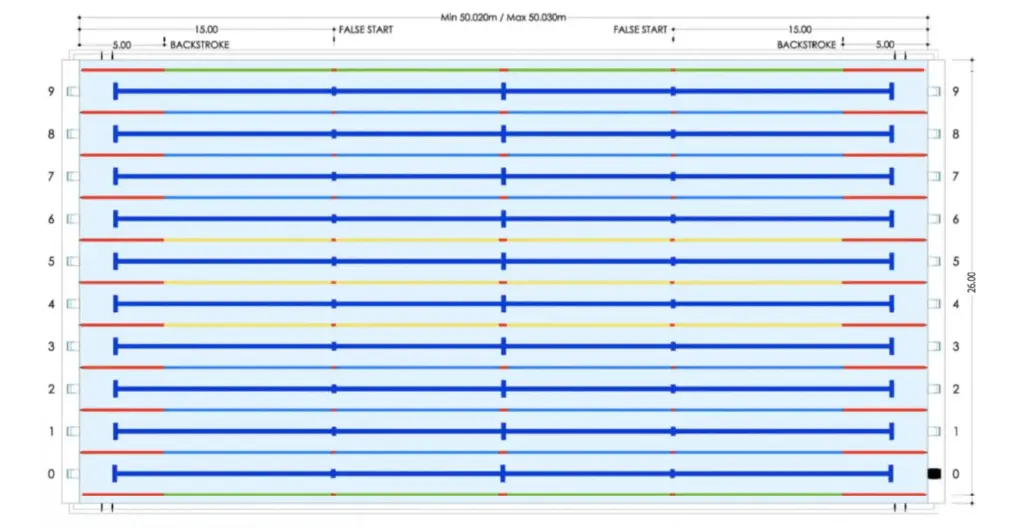
The competition pool must have a certified length of 50 metres from touchpad to touchpad for long-course and a certified length of 25 metres from touchpad to touchpad for short-course. The width of the pool depends on the number of lanes, for either an 8-lane or 10-lane competition configuration. Each lane must be 2.5 metres wide, and the pool length must remain within specified tolerances throughout the certified measurement zone. Additional buffer of width is needed for the outside lanes of both sides.
In addition to the pool structure itself, facilities must provide approved starting blocks, lane ropes, backstroke flags, timing systems, touchpads, scoreboards, and other competition equipment required by World Aquatics regulations.
- Length: 50 m
- Width: 25 m
- Commonly configured as either:
- 8-lane competition pool
- 10-lane competition pool
- Each lane width: 2.5 m
- Dimensions must remain within strict tolerances

What is the Difference Between an 8-Lane and 10-Lane Competition Pool?
One of the most common questions asked by many is whether to build an 8-lane or 10-lane competition pool.
An 8-lane pool provides eight racing lanes and is suitable for many national and regional competitions. A 10-lane pool, however, offers additional flexibility and is commonly used for World Championships and other major international events.
Whether its an 8-lane or 10-lane configuration, the outermost lanes are often used as wave-dampening lanes, helping to reduce turbulence in the central racing lanes. This results in improved competition conditions and makes the facility more attractive for hosting high-level events.
When planning a new aquatic facility, it is important to consider both current operational needs and future event-hosting aspirations.
- 8 lanes in a 10-lane pool commonly used for Olympics
- 10-lane pool for preliminary heats and semi-finals to manage high volumes of competitors,
- Additional lanes help reduce wave reflection
- Increased flexibility for competition operations
- Greater capacity for heats and events
What is the Minimum Depth Required for a Competition Swimming Pool?
Pool depth plays a critical role in swimmer performance and safety.
World Aquatics regulations require a minimum water depth of 1.35 metres in the area extending from 1 metre to at least 6 metres from the starting wall when starting blocks are installed. However, most modern competition pools are designed with significantly greater depths which can cater for other aquatic sport disciplines.
Deeper pools help reduce wave reflection from the pool floor, resulting in faster swimming conditions. This is one reason why many elite competition venues feature depths of 2 metres, 3 metres, or more throughout the pool.
For facilities seeking to host elite competitions, deeper pool designs are often recommended.
- Minimum depth of 1.35 m where starting blocks are installed
- Applies from 1 m to at least 6 m from the starting wall.
- Deeper pools generally provide faster swimming conditions
- Many modern competition pools exceed minimum requirements
- Pool depth affects wave dissipation and athlete performance
What are the World Aquatics Requirements for Starting Blocks?
Starting platforms are a critical component of competition swimming.
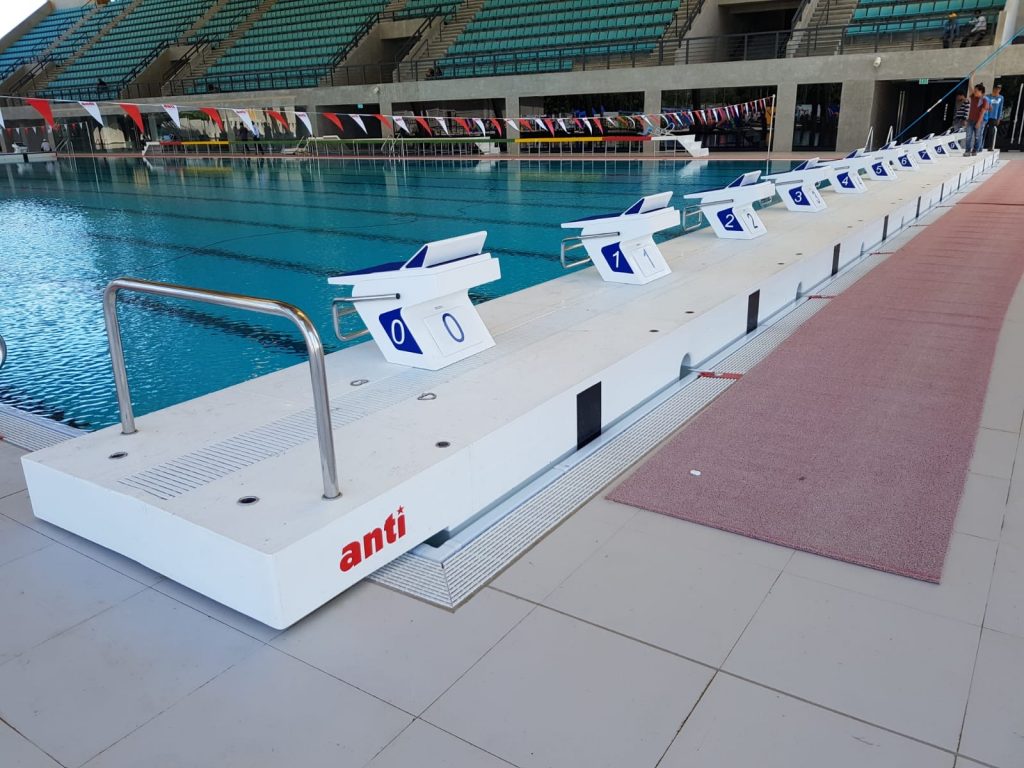
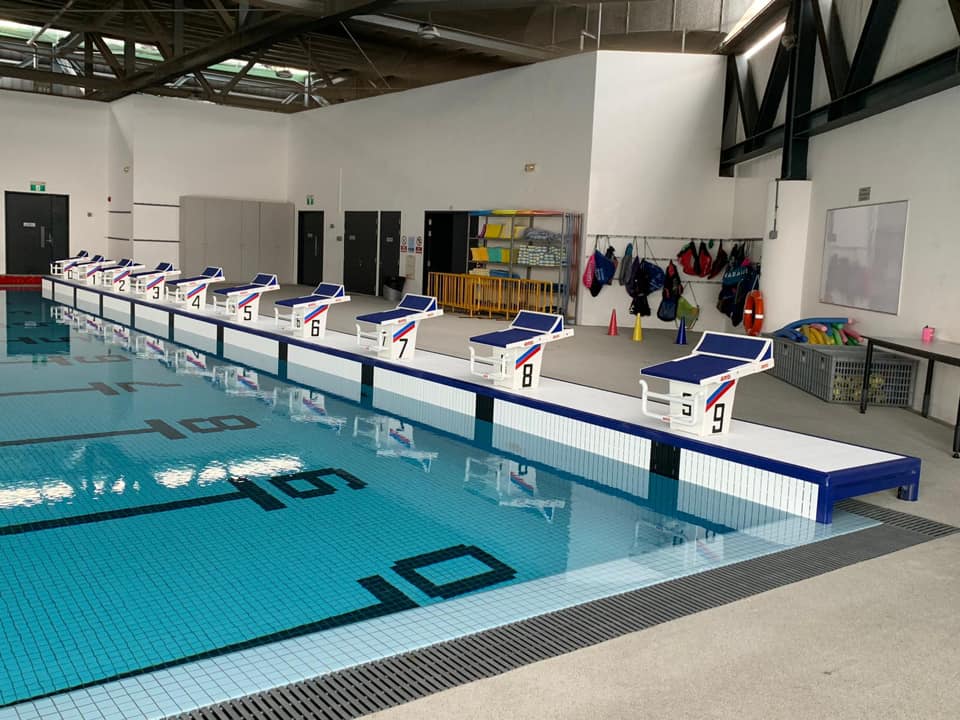
World Aquatics regulations specify that starting blocks need to be elevated 0.3 metres above the water surface by an end wall.
Many modern starting blocks incorporate adjustable track-start wedges, allowing swimmers to optimise their starting position. These wedges have become standard equipment at major international competitions and are commonly specified in new aquatic facility projects.
High-quality starting platforms can improve athlete performance while ensuring compliance with international regulations.
- Starting block above water: 0.3 m
- Non-slip surface required
- Includes adjustable track-start
- Block numberings
What are Touchpads in Swimming Competitions?
Touchpads are electronic timing devices installed at each end of a competition pool. They record swimmers’ finishing times automatically when touched at the finish or during relay exchanges.
Touchpads form part of a fully integrated timing system that includes starting devices, timing consoles, software, scoreboards, and results management systems.
Automatic timing systems are considered the highest level of timing accuracy and are mandatory for major competitions. Facilities that wish to host national championships or international events should invest in a reliable competition timing system that complies with World Aquatics standards. Currently, Omega is the primary Official Timekeeper for World Aquatics, a partnership that has spanned over five decades since 1973.
- Electronic timing panels
- Installed on end walls
- Record finishes and relay exchanges
- Integrated with automatic timing systems
- Required for major competitions

What are the Lane Rope Colour Requirements for Competition Pools?
Lane rope colours are used to help swimmers, officials, and spectators identify lane positions during competition.
In a standard competition pool, the centre lanes are marked using yellow lane ropes, while adjacent lanes are typically blue. The outermost lanes are generally green. Additionally, red markings are also used at key distances to indicate the first 5 metre of each end and 15 metre marks.
These colour arrangements provide visual consistency across international competitions and assist with race officiating and athlete orientation.
- Centre lanes: yellow
- Adjacent lanes: blue
- Outside lanes: green.
- Red markers indicate final 5 m before walls
- Red markings indicate 15m point from both ends
What are Backstroke Flags & Why are they Important?
Backstroke flags are installed 5 metres from each end wall of the pool and serve as a visual reference point for backstroke swimmers approaching turns and finishes.
The flags are suspended above the water surface and extend across the width of the pool. Without these markers, swimmers would have difficulty judging their distance to the wall while swimming on their backs.
Backstroke flags are a mandatory requirement for competition pools and are one of the most recognisable features of aquatic facilities worldwide.
- Backstroke Flags: Installed 5 m from each end wall, used by backstroke swimmers to provide visual reference for turns and finishes
- Suspended across pool width and mandatory in competition pools.
- False Start Rope: at 15.0 m from starting end, helps stop swimmers safely when false start
What is the difference between a Bulkhead and an End Wall?
The terms “bulkhead” and “end wall” are often confused during pool design discussions.
An end wall refers to the wall located at either end of the swimming pool. Swimmers start, turn, and finish against these walls.
A bulkhead, on the other hand, is a movable structure installed within the pool that can act as an alternative end wall. Bulkheads allow operators to divide a pool into multiple configurations, such as converting a 50-metre pool into two 25-metre pools.
For aquatic centres seeking maximum flexibility, bulkheads are often incorporated into the design to accommodate multiple user groups and event formats.
- End wall is permanent pool structure
- Bulkhead is movable or fixed internal structure
- Bulkheads can create multiple pool configurations
- Bulkheads may act as competition end walls
- Common in modern aquatic centres
What makes a Swimming Pool World Aquatics Compliant?
A World Aquatics-compliant pool must satisfy a wide range of technical requirements covering dimensions, tolerances, water depth, equipment specifications, timing systems, and competition infrastructure.
This typically involves detailed measurements and verification to ensure the facility meets the applicable standards. The process may include surveying the pool, inspecting competition equipment, and validating the timing system. Take note that there is no certification to deem a pool “World Aquatics Certified”. These details required makes the pool World Aquatics compliant.
For facility owners, achieving compliance provides confidence that the venue can host competitions conducted under internationally recognised standards.
Planning a World Aquatics Competition Pool
Designing a competition pool requires more than simply meeting minimum dimensions. Considerations such as pool depth, circulation systems, timing technology, spectator capacity, athlete experience, and long-term operational efficiency all play important roles in the success of an aquatic facility.
Whether you are planning a new competition venue, upgrading an existing pool, or exploring options for international-standard aquatic infrastructure, working with us at Spectrum Sports, experienced aquatic consultants and equipment specialists can help ensure compliance with World Aquatics requirements while maximising the value of your investment.
